

The Misericordia University Summer Undergraduate Research Fellowship Program (SURF) is sponsored by the Office of the Provost. Research fellows receive one-on-one, faculty-guided research opportunities and participate in bi-weekly professional development seminars geared toward preparing them for graduate school, future research experiences, and employment. The summer program culminates with two presentations of the students’ findings: a 10-minute oral presentation in the last week of the program and a poster presentation in the fall semester for the entire campus community..
-
Collectors, Copies, and Frauds: The Place of Authenticity in the Early US Art Market
Jasmine R. Bennett
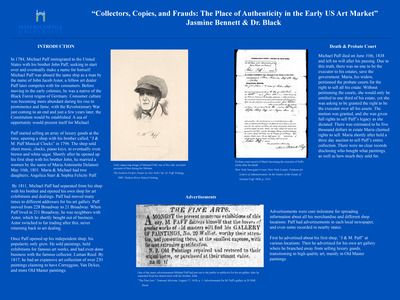
In the early American republic, immigrant entrepreneur Michael Paff helped lay the groundwork for the modern American art dealing industry. Emigrating from Germany's Black Forest region as a child, Paff evolved from a shopkeeper selling musical clocks and luxury goods into one of New York City’s popular art dealers of his time to eventually outmaneuvering rivals like John Jacob Astor. Operating out of prominent Broadway locations, Paff orangized exhibitions featuring hundreds of works attributed to Old Masters. Though later scrutiny uncovered widespread misattributions and fraudulent sales after his death, Paff's charisma, passionate restoration efforts, and passionate marketing methods captured the enthusiasm of early American collectors during his lifetime. Drawing on period census records, newspaper prospectuses, court petitions, and contemporary accounts, this biographical sketch examines Paff’s entrepreneurial impact, the legal and financial maneuvers of his widow Maria following his death, and his enduring legacy in American consumer culture.
-
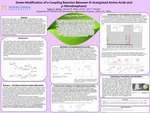
Green Modification of a Coupling Reaction Between N-Acetylated Amino Acids and p-Nitrothiophenol
Kaitlyn S. Marley, Hannah M. Werle, and John P. Morgan
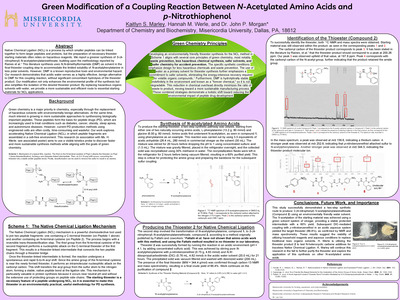
Native Chemical Ligation (NCL) is a process by which smaller peptides can be linked together to form larger peptides and proteins, but the preparation of necessary thioester starting materials often relies on hazardous reagents. We report a greener synthesis of S-(4- nitrophenyl) N-acetylphenylalaninethioate, building upon the methodology reported by Raines et al.1 This literature synthesis uses N,N-dimethylformamide (DMF) as solvent in the final thioester coupling step to accommodate the limited solubility of N-acetylphenylalanine in less polar solvents. However, DMF is a known reproductive toxin and environmental hazard. Our research demonstrates that acidic water serves as a highly effective, benign alternative to DMF for this coupling reaction, without significant concomitant hydrolysis of the thioester product. Our modification not only enhances the environmental profile of the synthesis but also simplifies the isolation of the desired thioester product. By replacing hazardous organic solvents with water, we provide a more sustainable and efficient route to essential starting materials for NCL applications.
-
Navigating Academic Demands in Higher Education after Mild Traumatic Brain Injury
Abigail Mosteller and Chitrali R. Mamlekar
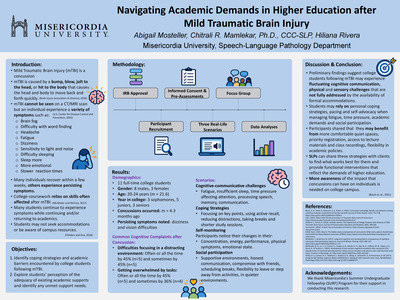
Although, mild traumatic brain injuries (mTBI) are classified as mild; their consequences can be substantial. These injuries can result in significant cognitive, physical, and emotional symptoms. While many individuals recover within a few weeks, others experience persisting symptoms such as headaches, dizziness, fatigue, brain fog, difficulties with attention and memory. For college students, these ongoing symptoms can significantly interfere with academic participation and success, impairments in communication, executive functioning, processing speed, memory, or attention may make it difficult to follow lectures, complete assignments, meet deadlines and study effectively. Universities may offer accommodations and academic support services; however, the availability of support does not necessarily mean that students' needs are fully addressed. Therefore, it is important to move beyond identifying whether support exists and examine how students experience these supports and what unmet needs remain. Understanding these perspectives can provide speech-language pathologists with valuable insight into real-world academic consequences of persistent cognitive-communication symptoms. This knowledge can help SLPs develop more individualized strategies and functional interventions that reflect the demands of higher education. Eleven full-time college students (8 males, 3 females; ages 20–24 years; M=21.6) who reported mTBI within the previous 12 months completed NIH Cognitive Battery and Common Cognitive Complaints after Concussion measures, three weekly scenario-based prompts, and an open-ended focus group. Participants represented five universities and diverse majors. Participants reported concussions 1–7 months before participation (M=4.2 months), with dizziness and visual difficulties most frequent. Focusing in distracting environments was reported as occurring often or always by 45% (n=5) and sometimes by 45% (n=5). Preliminary scenario findings from six participants revealed four themes: cognitive-communication challenges, strategic compensation, self-monitoring, and flexible, supportive environments. Fatigue, insufficient sleep, and time pressure affected attention, processing, memory, and communication. Participants used recording, active recall, distraction reduction, and task pacing to manage demands. Supportive peers and flexible environments facilitated self-advocacy and social participation. Focus groups analyses are ongoing. Students may experience fluctuating cognitive-communication challenges that extend beyond formal accommodations. SLPs can incorporate students’ strategies and experiences into individualized interventions targeting academic and social participation.
-
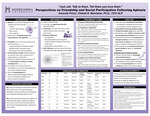
Perspectives on Friendship and Social Participation Following Aphasia
Amanda Prinzi
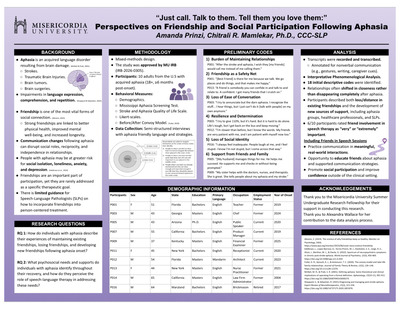
Aphasia can affect friendships, social participation, and overall quality of life. This qualitative study explored how people with aphasia perceive changes in their friendships and social participation following aphasia onset and how speech-language pathology services can address those changes. Participants completed semi-structured interviews and a Convoy Model of Social Relations. Interviews were analyzed using Interpretative Phenomenological Analysis and thematic analysis. Preliminary findings highlight changes in relationship closeness, reduced social contact, communication challenges, and the importance of supportive relationships and connections with others with aphasia. Findings emphasize the need to consider friendship and social participation as important components of person-centered aphasia care.
-
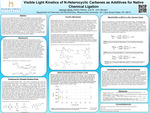
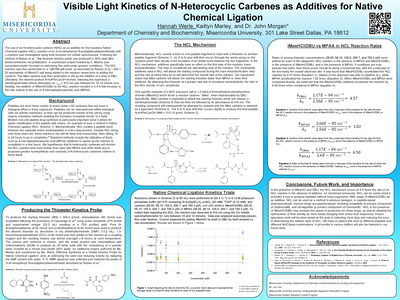
Visible Light Kinetics of N-Heterocyclic Carbenes as Additives for Native Chemical Ligation
Hannah M. Werle, Kaitlyn S. Marley, and John P. Morgan
Spectroscopic data have been obtained demonstrating that N-heterocyclic carbenes are effective catalysts for linking shorter peptides to form longer ones, a reaction known as “native chemical ligation” (NCL). This reaction is key to the preparation of GLP-1 agonists, such as Zepbound®, Ozempic®, and Wegovy®, which are currently undergoing an explosion in popularity due to their treatment of diabetes, obesity, and cardiac issues. To assess which catalysts are faster, the kinetics model developed by Raines et al., involving the reaction of N-acetylphenylalanine p-nitrophenylthioester and L-cysteine, is being utilized. This published model allows for easy monitoring of the rate of reaction for NCL catalysts by observing the change in absorption of indigo light by the product, p-nitrothiophenolate, using a UV/Visible spectrophotometer as the reaction proceeds. We proposed that our NHC catalysts would outperform MPAA in these rate measurements. N-heterocyclic carbenes additionally offer an attractive alternative to MPAA because they are potentially more reactive, even in water. The development of better NCL catalysts is therefore of paramount importance as the environmental and economic impacts of these drugs continue to dramatically rise in the short and long term.