

Faculty Advisor(s)
Chitrali Mamlekar
Files
Download Poster (644 KB)
Abstract
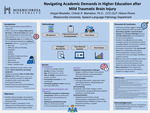
Although, mild traumatic brain injuries (mTBI) are classified as mild; their consequences can be substantial. These injuries can result in significant cognitive, physical, and emotional symptoms. While many individuals recover within a few weeks, others experience persisting symptoms such as headaches, dizziness, fatigue, brain fog, difficulties with attention and memory. For college students, these ongoing symptoms can significantly interfere with academic participation and success, impairments in communication, executive functioning, processing speed, memory, or attention may make it difficult to follow lectures, complete assignments, meet deadlines and study effectively. Universities may offer accommodations and academic support services; however, the availability of support does not necessarily mean that students' needs are fully addressed. Therefore, it is important to move beyond identifying whether support exists and examine how students experience these supports and what unmet needs remain. Understanding these perspectives can provide speech-language pathologists with valuable insight into real-world academic consequences of persistent cognitive-communication symptoms. This knowledge can help SLPs develop more individualized strategies and functional interventions that reflect the demands of higher education. Eleven full-time college students (8 males, 3 females; ages 20–24 years; M=21.6) who reported mTBI within the previous 12 months completed NIH Cognitive Battery and Common Cognitive Complaints after Concussion measures, three weekly scenario-based prompts, and an open-ended focus group. Participants represented five universities and diverse majors. Participants reported concussions 1–7 months before participation (M=4.2 months), with dizziness and visual difficulties most frequent. Focusing in distracting environments was reported as occurring often or always by 45% (n=5) and sometimes by 45% (n=5). Preliminary scenario findings from six participants revealed four themes: cognitive-communication challenges, strategic compensation, self-monitoring, and flexible, supportive environments. Fatigue, insufficient sleep, and time pressure affected attention, processing, memory, and communication. Participants used recording, active recall, distraction reduction, and task pacing to manage demands. Supportive peers and flexible environments facilitated self-advocacy and social participation. Focus groups analyses are ongoing. Students may experience fluctuating cognitive-communication challenges that extend beyond formal accommodations. SLPs can incorporate students’ strategies and experiences into individualized interventions targeting academic and social participation.
Publication Date
2026
Document Type
Poster
Department
Speech-Language Pathology
Keywords
Speech-Language Pathology, Speech Therapy, Mild Traumatic Brain Injury, mTBI, Concussion, Higher Education, College Students
Disciplines
Medicine and Health Sciences | Speech Pathology and Audiology
Recommended Citation
Mosteller, Abigail and Mamlekar, Chitrali R., "Navigating Academic Demands in Higher Education after Mild Traumatic Brain Injury" (2026). SURF Posters 2026. 3.
https://digitalcommons.misericordia.edu/surf2026/3