

Faculty Advisor(s)
Lynn Blazaskie
Abstract
Abstract
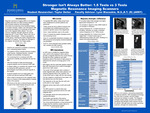
Magnetic resonance imaging (MRI) is an imaging modality that does not use ionizing radiation. Instead, MRI uses magnetic fields, gradience, coils, and radio frequency to provide anatomic and physiologic information. The purpose of the research study is to examine the strengths and weaknesses of a 1.5 tesla to a 3-tesla magnetic resonance imaging scanner. Cross sectional images are produced to better visualize muscles, organs, and soft tissues for diagnostic purposes. MRI screening and safety is a crucial part of the modality. The most common magnetic strength used for clinical diagnosis are 1.5 and 3 teslas. The higher the strength of the magnet, the greater the image quality and with emerging technology, the scan time is quicker, and the images produced are sharper in quality. However, higher magnetic strengths create safety concerns and implant sensitivity that require a lower field strength such as the 1.5 tesla scanner; therefore, screening and patients’ safety is crucial. An increase in magnetic strength causes an increase in energy deposition, raising the bodies core temperature. The increase in energy deposition is what causes implant sensitivity, meaning not every patient is suitable on the higher tesla scanner. Therefore, there is still a need for the 1.5 tesla scanners over the higher strength magnets. This proves that stronger isn’t always better.
Keywords: 1.5 tesla, 3 tesla, MRI scanners, safety, magnetic strength
Publication Date
2026
Document Type
Poster
Department
Medical Imaging
Keywords
1.5 tesla, 3 tesla, MRI scanners, safety, magnetic strength
Disciplines
Medicine and Health Sciences | Radiology
Recommended Citation
Deiter, Taylor, "Stronger Isn't Always Better: 1.5 Tesla vs 3 Tesla Magnetic Resonance Imaging Scanners" (2026). Student Research Poster Presentations 2026. 11.
https://digitalcommons.misericordia.edu/research_posters2026/11